
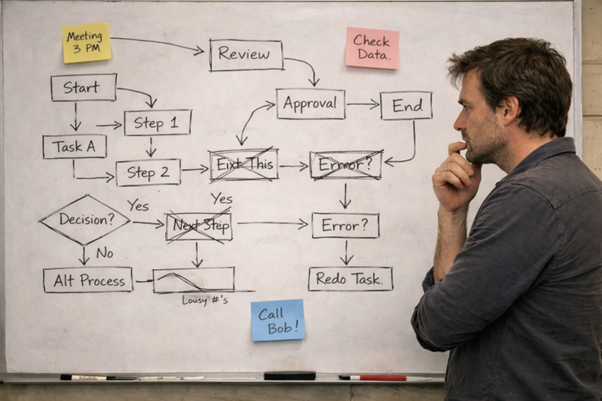
The cost of building software has fallen sharply.
AI tools can now generate forms, workflows and even working applications in minutes. For many organisations, that changes what’s possible.
But it doesn’t change where most systems go wrong.
The expensive part of building a system was never the typing. It was deciding what should exist in the first place.
When systems fail, it’s rarely because the interface looks wrong. It’s because the system reflects assumptions rather than reality.
- Steps are modelled as they were imagined, not as they are performed.
- Exceptions are treated as anomalies, even though they happen daily.
- Decisions that live in someone’s head are never surfaced or documented.
- Workarounds quietly become part of the “process.”
AI doesn’t remove that risk.
It accelerates whatever description it is given.
If the understanding of the work is shallow, the resulting system will faithfully encode that shallowness — just faster and at lower cost.
That speed is impressive. It also makes it easier to build the wrong thing with confidence.
The real work still happens earlier:
- Observing how work actually flows end-to-end.
- Identifying where friction and rework are introduced.
- Clarifying where judgment is required.
- Distinguishing rare exceptions from everyday variation.
Once that clarity exists, implementation is often straightforward — and AI can be extremely helpful.
But implementation follows understanding.
When execution becomes cheaper, the cost of misunderstanding becomes more visible, not less.
AI changes the economics of building.
It does not remove the need for careful thinking about what is being built.
In practice, most expensive systems don’t fail because they were built badly. They fail because they were understood badly.